Posted on Leave a comment

The Bloom Within the Glass

About Fungus in Lenses

It begins quietly, almost invisibly, as most forms of decay do. A lens sits too long in its leather case, in a cupboard that has known one too many winters. When you lift it out, turn it toward the light, you notice the faintest tracem, a soft filigree across the inner glass, like frost that has forgotten how to melt. That is how the fungus announces itself. Not with corrosion or catastrophe, but with a whisper of life where there should be none.

Inside the sealed darkness of a Nikon lens, the conditions are perfect for something microscopic to dream of growth. There is warmth, the residue of skin oil, a touch of organic dust, and above all the endless night between the elements. The spores, ever patient, wake when the air grows damp. They weave their threads across the coatings, following the faint geometry of the optics, until the glass itself begins to resemble a tiny overgrown garden. It’s beautiful in its own way. Tragic, delicate, and strangely alive.

What astonishes me is how little this invasion seems to matter to the image. I have looked through lenses with visible fungal webs, expecting disaster, and found the photograph unchanged. Sharpness still bites, contrast holds, the world appears with its usual insistence. If anything, the light feels gentler. The edges soften just enough to remind me that perfection is an illusion; that a trace of imperfection may be the final ingredient of character. Perhaps the fungus functions as a natural diffuser, filtering the zeal of modern contrast through an organic veil. The lens breathes differently. Less like a machine, more like a living thing that has aged with grace.

Of course, one should not romanticize it too much. Fungus eats coatings, and coatings are the skin of optics. Left long enough, the bloom turns to etching, the threads bite into glass, and the lens begins to die. Yet even that carries a certain poetry. A fungus-ridden Nikkor is not a failed instrument but a memento of storage and neglect, of travels unmade, of light withheld too long. Every mark in the glass tells a story about human absence, about what happens when precision is left alone in the dark.

Prevention is simple, though it too has the air of ritual. Lenses prefer dry air, open shelves, and a little sunlight now and then. They dislike confinement, dislike silence. A lens that sees the world regularly seldom molds; its own use becomes its best medicine. There is a moral there, I think: that objects, like people, decay fastest when forgotten.

If the fungus has already taken hold, the cure is half science, half patience. Dry the air, separate the infected lens, give it a few hours of daylight. The ultraviolet will do what it has done for eons, remind living things of their limits. Some photographers send their lenses off for surgery, where a technician opens the body and wipes away the web. Others, like me, sometimes leave it alone. The damage, if it can be called that, becomes part of the lens’s biography. I have known Nikkors that carried their faint ghosts of mold for decades, still making images with a quiet, human softness that no modern coating could replicate.

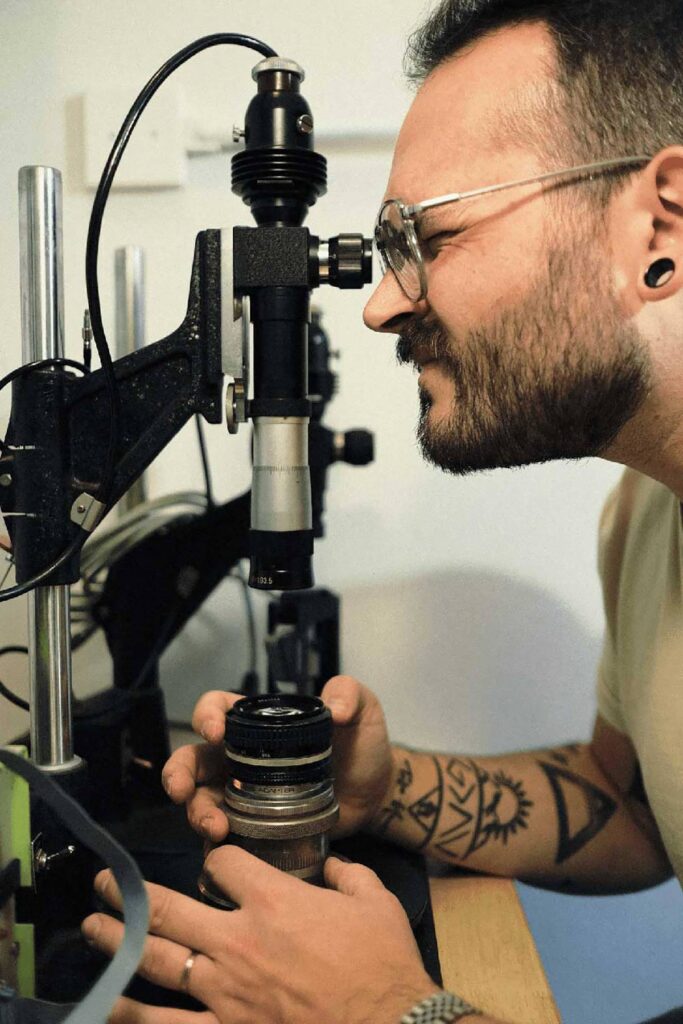
There is, beneath the microscope, a metaphor here for photography itself. The same conditions that feed the fungus: darkness, humidity, neglect, also surround the latent image before it meets the light. Both are acts of waiting, of suspended transformation. Perhaps that is why I’ve come to regard fungus not only as a fault, but as a reminder of the delicate line between creation and decay. Every lens is a small ecosystem, and every photograph is a brief clearing in the fog.

So I clean what can be cleaned, dry what must be dried, and accept the rest as patina. A trace of fungus inside a fifty-year-old Nikon lens does not ruin its vision; it merely adds another layer of time to the glass. And when I look through it, I sometimes imagine that what I see, that gentle bloom softening the light, is not damage at all, but the quiet memory of a world once stored away, still waiting to be seen.

Posted on Leave a comment

The Photographer as Suspect

Antonioni's Blow-up
Antonioni's Blow-up

When the camera became the weapon and the witness

There was a time when photographers were explorers of light. They carried cameras as if they were instruments of wonder, mapping the visible world one exposure at a time. Somewhere in the late twentieth century, that faith began to fracture. The photographer, once the romantic witness to truth, slowly turned into a figure of suspicion. In film, in fiction, even in everyday conversation, the one who looks has become the one who must be watched.

I have been a photographer for most of my life. I have seen people nervous before the camera, and I have learned to read that nervousness as a form of defense. Some smile too much, some pull their shoulders in as if preparing for impact. They are not afraid of me as a person, but of what I represent: the photographer, the one who might take too much, who might see what should remain unseen. In every lens, they seem to glimpse all those other photographers, especially the ones from films, from novels, from television, who were never quite innocent.

Somewhere in the late twentieth century, the photographer ceased to be a romantic figure. The old press-card hero with his Speed Graphic, the explorer with a Nikon slung over his shoulder, the studio master shaping light like a painter, they seemed to fade away. In their place came the photographer as suspect. In the stories told from the seventies onward, he is restless, obsessive, voyeuristic, often dangerous. He peers through curtains, photographs strangers, manipulates his models. His camera is no longer a tool for revelation but an instrument of power.

It began with Antonioni’s Blow-Up, where a fashion photographer in swinging London enlarges his negatives until they dissolve into abstraction and presumed evidence of murder. The closer he looks, the less he knows. Then came Eyes of Laura Mars, Columbo’s murderous artist with a darkroom in his basement, and a procession of others. The photographer became the man who sees too much, the woman haunted by her own gaze, the teacher who uses art as camouflage for predation, the photojournalist who sells catastrophe framed in perfect composition.

In these fictions, photography is never neutral. The shutter doesn’t just capture light; it steals it. The act of looking is suspect, and the act of recording even more so. The public, fed on these stories, learned to associate the camera with intrusion. Every flash in an alleyway or at a party might conceal a darker intention. Every photographer could secretly be a voyeur, a manipulator, a person willing to trade intimacy for an image.

Meanwhile, those of us who actually work with cameras — who earn our living through observation, patience, and trust, will have to live under that shadow. I have never been a suspect. I have never committed a murder, never violated the fragile contract between subject and photographer. I have only tried to make honest pictures. And yet, I can feel the weight of those fictional colleagues every time I lift my camera.

A model will sometimes glance away when the lights come on, guarding herself against the invisible archive that culture has built around my profession. The memory of all those films hangs between us: the photographer as manipulator, the image as trap. I spend the first half hour of every session not adjusting lenses or light but dismantling that mythology — proving that I am not one of them. I listen, I ask, I explain what will happen, what the purpose is, where the image will go. Only then does the tension ease and the collaboration begin.

It is a strange inheritance, to work in a craft that fiction has so thoroughly corrupted. The writer is rarely portrayed as a murderer because he writes, nor the painter as a voyeur because he paints. But the photographer carries suspicion by default. Maybe, because we deal in fragments of reality, the surface of things, frozen and detached from their story. Perhaps because we touch that uneasy border between truth and representation, where the ethical question always lingers: what right do we have to look?

For me, photography has always been an act of empathy, not domination. It requires trust, listening, and a willingness to see without consuming. Yet the old fictions linger, shaping how the world reads every click of the shutter. The lens is still seen as a weapon, the darkroom as a crime scene, the photograph as evidence of something illicit. It is as if the image itself must always come at a price.

I sometimes think those stories reflect less on photographers than on the age that produced them. The twentieth century began with faith in images and ended with fear of them. Cameras multiplied, surveillance spread, the photograph became proof, blackmail, pornography, propaganda. The artist who once revealed beauty now exposes corruption. The witness becomes the accused.

And so I continue to photograph, quietly and without apology. Each session is a small negotiation between truth and myth, between the suspect and the professional. I have learned that trust, once earned, outshines suspicion. But I also understand why it must be earned anew every time. In a world that has made the photographer its favorite villain, the first thing I have to capture is faith, before I can capture anything else.

Posted on Leave a comment

The Secret Bite of Old Nikkors

Every photographer who has spent time with Nikon’s older manual lenses knows the feeling. You mount a sturdy AI-S or even a pre-AI Nikkor on a modern camera, take a few shots, and suddenly the image seems to come alive. Rich blacks, snappy midtones, a kind of density that feels unmistakably film-like. Then you switch to a recent, clinically perfect Z-series lens, and while the sharpness is staggering, something subtle has gone missing. The picture is cleaner, but somehow smoother. Almost too polite.

Why does that happen?

Part of the answer lies in the way older lenses were designed to meet the needs of film. Film could handle light from odd angles and gentle internal reflections. Lens designers of the 1960s and 1970s balanced sharpness with character, using relatively simple formulas and fewer glass elements. That simplicity allowed light to move through the lens with a kind of raw directness. The image that landed on film had bold transitions between light and shadow, what photographers often call microcontrast. It’s what gives a photograph its sense of shape and volume.

Modern lenses, by contrast, are built for digital sensors, and digital sensors are far less forgiving. They need light to strike them in near-perfect alignment, and they reveal every optical flaw in merciless detail. To satisfy that precision, Nikon and other makers added aspherical elements, exotic glass types, and complex coatings. These advances eliminate flare, distortion, and chromatic aberration. They also produce stunningly even sharpness across the frame. Yet each new layer, each extra surface, slightly tames the unruly reflections that once gave older lenses their punch.

It’s a bit like the difference between a studio recording and a live performance. The modern lens delivers every note perfectly, but the older one leaves a little grit in the sound. A shimmer of imperfection that makes the image feel alive.

Even Nikon’s coatings play a part in this transformation. The early multicoatings of the AI and AI-S era didn’t suppress flare quite as aggressively as today’s Nano Crystal or ARNEO coatings. Instead, they allowed a whisper of internal light to bounce around, deepening shadows and enriching colors. On film, this created a beautifully balanced contrast that seems to jump off the page even decades later.

None of this means that modern Nikon lenses are inferior. They’re extraordinary feats of optical engineering; bright, consistent, and capable of resolutions that their predecessors could never reach. But the rendering, the way they draw the world, has changed. Where an old 105 mm f/2.5 carves its subject out of the background with sculptural clarity, a new 85 mm f/1.8 S paints the scene in silken gradients. The older lens emphasizes form; the newer one emphasizes perfection.

In the end, both have their place. The choice is less about right or wrong and more about mood. If you crave that crisp, three-dimensional “bite” that defined Nikon’s golden era, there’s still nothing quite like turning the smooth metal focus ring of a classic Nikkor and letting a little history slip back into the light.

Posted on Leave a comment

The Weight of Intention

There was a time when cameras were built to last longer than their owners. The Nikon F and F2 belonged to that time. You could drive a nail into wood with one and still make your next frame. I know, because I’ve done it. The dents in the bottom plate are still there, like war medals from a less forgiving age.

I handed a Nikon F4 to a friend and he said, “See, that doesn’t feel good at all!” I understood what he meant, and why he was wrong. He was holding a tool that was never meant to balance in one hand. It’s not a compact camera; it’s a machine built for both hands, for purpose, for intention.

Ergonomics came late to Nikon. The early F and F2 were made for professionals who already knew how to hold them, who had learned to brace their bodies around a shutter speed. Comfort was secondary to control. Those cameras were not designed to please the hand; they were designed to obey it.

With the F3, a shift began. The Italian designer Giorgetto Giugiaro gave Nikon a new kind of confidence; a hint of sculpture, a red accent line, a suggestion that the tool could also be beautiful. But it wasn’t until the F4 that Nikon fully embraced the idea that a camera could fit the photographer, rather than the other way around. Rounded contours appeared. Buttons found their way under natural fingertips. It was still heavy, still unapologetically metal, but suddenly it felt deliberate, like a bridge between the mechanical age and the electronic one.

To those raised on the lightweight polycarbonate bodies of DSLRs, the F4 feels like a relic. To those who grew up with brass and titanium, it feels like the last camera that demanded respect. You don’t use an F4 casually; you commit to it. Its weight steadies you. Its shutter insists on attention. You photograph with it, not through it.

Modern ergonomics are brilliant in their own way. Cameras now mold to the hand as naturally as a phone. But something was lost along the way; the sense that you were operating a precision instrument, that your body had to meet the machine halfway. The old Nikons didn’t flatter you. They asked you to show up, to hold steady, to mean it.

Perhaps that’s why the F4 still feels so honest. It carries the last trace of the era when cameras were designed for people who didn’t expect to be comfortable. They were expected to get the shot.

Posted on Leave a comment

The Music of the Shutter

You could tell if a Nikon was still healthy just by listening to it. After a fall, before checking the frame counter or winding the film, you pressed the shutter release and waited for the sound, that precise, metallic rhythm that told you everything was still aligned. If the music was right, the camera was right.

Each Nikon had its own distinct voice. The F delivered a sharp, confident clack, like the closing of a rifle bolt. The F2 refined that sound – faster, cleaner, a percussive precision that spoke of tighter tolerances. The F3 softened it, introducing an almost polite restraint with its electronically timed shutter. And then came the F4: still unmistakably mechanical, but with a deeper tone — the resonance of metal meeting modernity.

Those sounds were never designed for beauty, but they became beautiful all the same. They were the audible language of reliability. Long before diagnostic screens and firmware updates, photographers trusted their ears. The rhythm of the shutter, the recoil of the mirror, the clean return of the wind lever… These were signals that the machine was alive and ready.

It was a kind of mechanical music. You didn’t just hear it; you felt it through the fingertips, in the tension of the shutter release, in the way the body balanced against the pull of the film advance. After enough rolls, you could recognize your own camera by sound alone, even in a room full of them.

Today, cameras whisper. The electronic shutters of the Z-series barely register as sound at all — a faint click, simulated for comfort. Technically, this silence is progress: no vibration, no wear, no mechanical delay. Yet something essential is missing. The shutter’s song once marked the moment of commitment. The instant when light, time, and trust converged.

Without that sound, photography feels quieter in more ways than one. There’s less ceremony in the act. You no longer listen to your camera; you simply assume it works. The ritual has disappeared, replaced by confidence in systems that no longer speak.

The music of the shutter was more than nostalgia. It was communication — feedback from a machine that needed you as much as you needed it. And like the subtle hum of an old hard drive or the rumble of a Harley engine, it carried both function and feeling. You could tell when something was off long before it failed completely.

Even now, when I press the shutter on a silent mirrorless camera, I still wait for the echo that isn’t there. It’s a reflex built over decades, an auditory ghost that refuses to fade. Somewhere inside, I’m still listening for the Nikon that answers back. The sound that once told me the camera was alive, and that, for a brief moment, so was I.

Posted on Leave a comment

The Persistent Myth of the UV Filter

The ultraviolet filter is one of those curious photographic relics that somehow managed to outlive its original purpose. In the early days of color film, when emulsions were less sophisticated and more sensitive to ultraviolet light, these filters had a real and measurable function. They reduced the bluish haze that appeared in mountain landscapes or on the open sea, where invisible ultraviolet light could trick film into recording a milky veil over distant subjects. In those days, the filter was not a fashion accessory. It was a modest but functional part of a photographer’s kit.

With the arrival of digital sensors, that need disappeared. Every modern sensor sits behind a multi-layered assembly of protective glass and coatings that already block ultraviolet and infrared light. The UV filter quietly lost its function, but not its place in the shop window. Manufacturers and retailers simply changed the story. What had once been an optical aid became a “protective filter” – a kind of insurance policy for anxious photographers. The argument was simple: better to scratch or break a ten-euro filter than a multi-element lens.

It sounds reasonable until you look more closely. The front element of a good lens is not fragile. It is made from hardened optical glass, often coated several times over, and can tolerate a surprising amount of abuse without any visible or measurable effect on image quality. A fine scratch on the surface has almost no influence on the optical performance of a lens. Light scatters so little over such a narrow groove that the sensor – or film – simply ignores it.

What does affect image quality, however, is the addition of another piece of glass, particularly a cheap one. Each extra surface introduces the possibility of internal reflections, veiling flare, and those telltale rainbow-coloured ghosts when sunlight hits at a certain angle. The filter, which once improved the purity of an image, now risks degrading it. The irony is hard to miss.

The idea of protection is itself slightly misplaced. A rubber or metal sun hood offers far better physical protection than a wafer-thin piece of glass ever could. A hood shields against impact, stray light, and the photographer’s own fingers – and, when it is deep enough, it absorbs the kind of knocks that would simply shatter a filter. The lens itself remains unharmed, its coatings intact, its front element safely recessed.

It is also worth remembering that glass, in its most basic form, is nothing more than hardened sand. Photographers often fear scratches on the front surface as though a few microns of glass could decide the fate of an image. Yet the rear element — the one part of the lens that genuinely matters most for image quality — is rarely given a second thought. That is where even the smallest imperfection can alter sharpness, introduce ghosting, or change contrast. The fear of damaging the front is largely symbolic; it speaks more to psychology than to optics.

In the end, the ultraviolet filter has become an artifact of habit. It lingers because it gives a sense of safety, and perhaps because it makes the lens look complete. There are still moments when one might justify its use – during chemical work, or in a saltstorm on a pier — but for most photographers it has become little more than a pane of glass between the image and the world.

Those who value their lenses, and their images, might consider letting the air touch the front element again. A clean piece of glass, unfiltered, remains one of the most honest instruments in photography.